
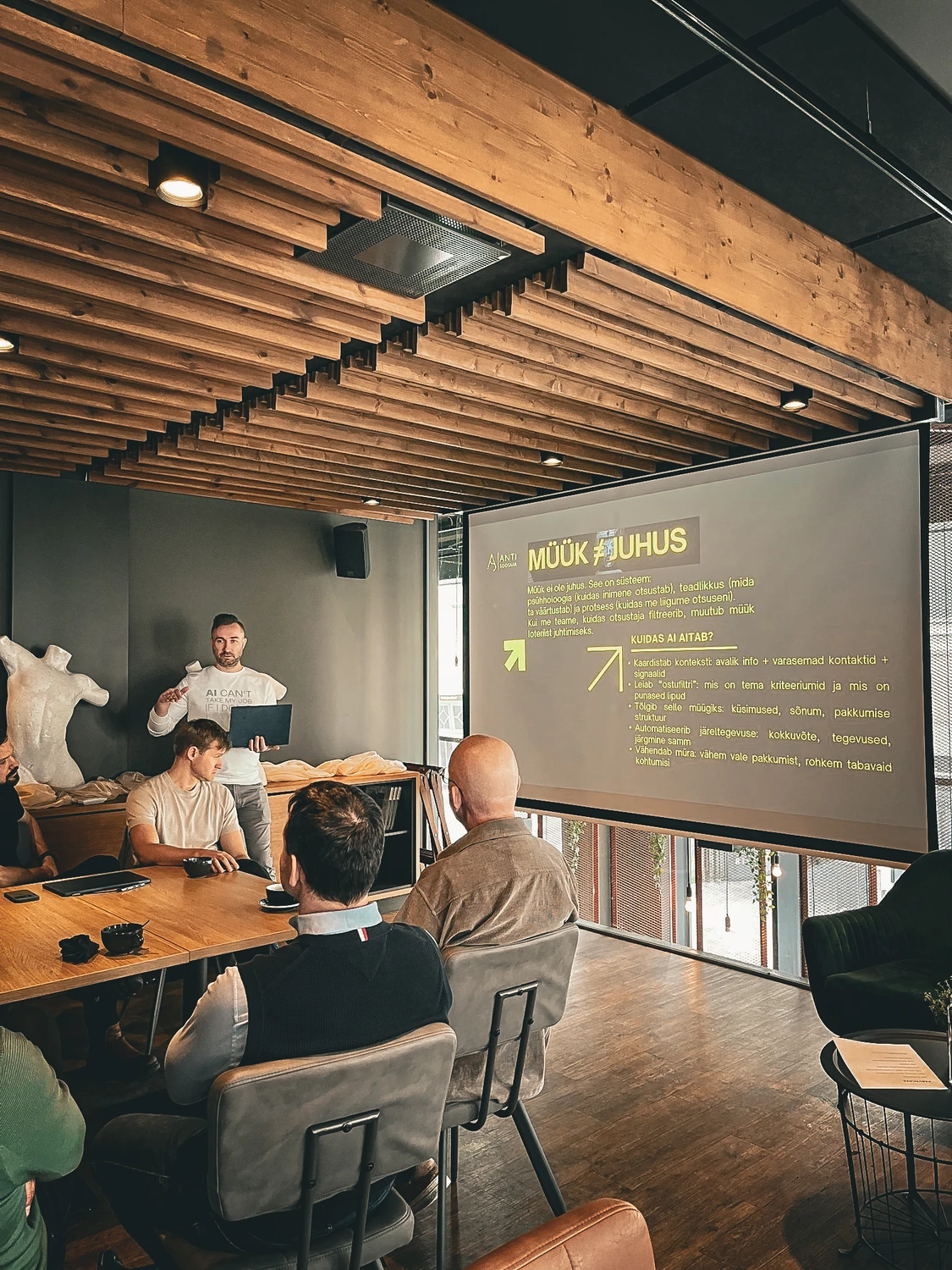
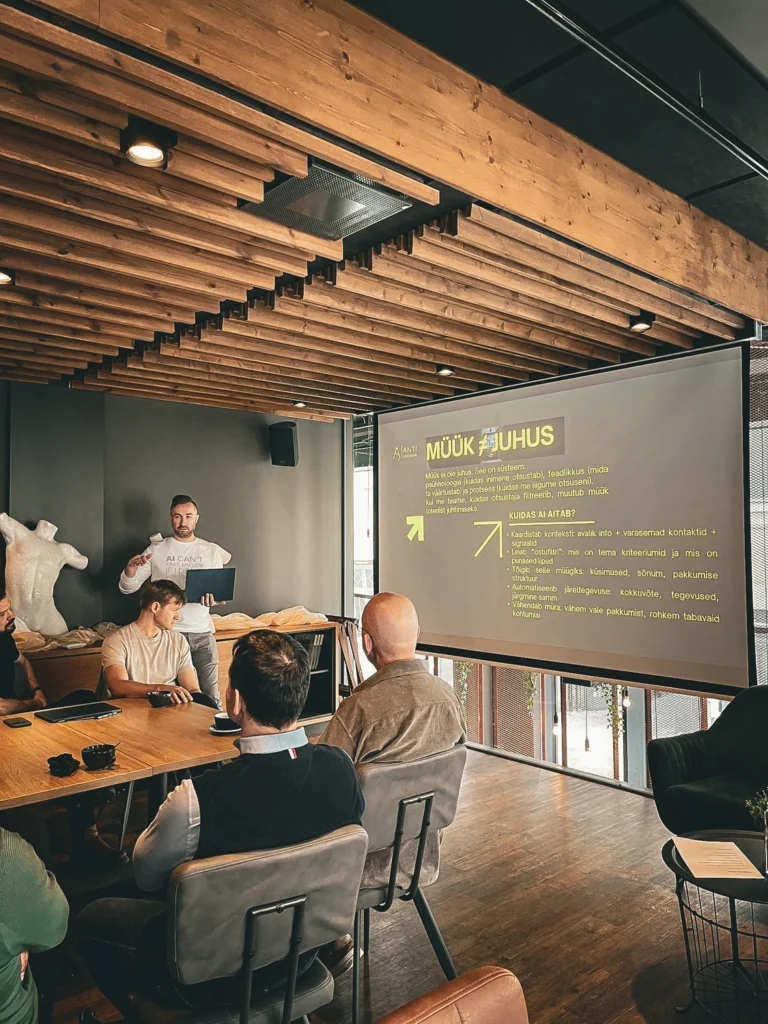
In January 2026, I gave a 40-minute presentation titled ‘AI × Sales’ to executives from Rand & Tuulberg group companies. The focus was how AI can help sales teams prepare for customer meetings systematically and with better information.
This article shares the main messages, practical tools and feedback from participants.
The problem: a customer you know almost nothing about
Every salesperson knows the feeling. You arrive at a meeting knowing only the customer’s name and perhaps their job title. Then comes a blind encounter: you offer something, hope for the best and see whether anything resonates.
That wastes time.
Going into a meeting completely unprepared is a serious mistake. Without relevant customer context, an offer rests on assumptions, wasting our most valuable resource: time.
An example situation:
- We know only the person’s name and role.
- We do not know which offer fits; our portfolio contains hundreds of products.
- We do not know how best to explain the value.
- That makes selling difficult.
The solution: AI as a sales-preparation tool
The presentation’s main message was simple: sales is not chance. It is a process.
That process has three parts:
- Psychology : how people make decisions.
- Awareness : what matters to them.
- Process : how we move towards a decision.
Understanding a decision-maker’s information needs helps make sales preparation more deliberate.

The method: three steps to understanding the context
Step 1: in-depth research
First, gather relevant public professional information: articles, interviews, LinkedIn posts, company announcements and conference talks.
AI research tools such as ChatGPT or Claude can help assemble this much faster than manual searching. The time required depends on the task, and the sources still need checking.
What to look for:
- Which professional topics interest them?
- How do they communicate?
- What positions have they publicly expressed?
- Which projects are they involved in?
Step 2: a working profile
The collected information helps us form questions and working hypotheses:
- What professional goals may motivate them?
- What concerns have they expressed?
- What does their decision process involve?
- Which purchasing criteria matter?
These are patterns in public information, not verified psychological facts. Assumptions need to be tested through conversation.
An illustrative profile from the presentation:
‘Focuses on results: value should be measurable in the coming months. Prefers a clear, concise message: problem → impact → risk. Values systems and routines: metrics, responsibility and a consistent work cycle. Seeks predictability: fewer surprises and deviations. Prefers practical evidence: a short pilot with clear results.’
A profile like this gives you a starting point for the conversation, not certainty about a person.
Step 3: choosing an approach
Use the context to select relevant products or services and prepare a specific approach.
Questions to answer:
- What value is this person looking for?
- How can we explain the offer clearly in their context?
- What objections might need discussion?
- What is the next step?
A practical example: using AI to prepare a sales strategy
In the second part of the presentation, I demonstrated how AI can help prepare competitor research and a sales strategy.
Using an Estonian manufacturing company as an example, I showed how an AI-assisted 40-minute session could help us:
1. Map the competitive landscape : who is in the market, their strengths and weaknesses, and how they position themselves.
2. Identify opportunities for growth : underserved customer segments, obstacles in the buying journey and offer elements that may improve the chance of success.
3. Prepare an action plan : specific steps, measures and responsibilities.
The result was a strategy document drafted in one session, for work I would otherwise expect to take days.
That does not mean AI does all the work. A person must validate the result, adapt it and make decisions. AI helps make the preparation faster and more systematic.
What participants said
We collected anonymous feedback at the end. A few comments, translated from Estonian:
‘The trainer knew the subject very well and had put considerable effort into preparing the training.’
‘The right, precise question is important!’
‘When using AI, we must retain critical judgement and check thoroughly.’
‘The human factor is very important with AI.’
‘A directed AI agent helps us understand a customer more accurately from public information.’
That last point matters. AI does not replace the salesperson; it provides tools for better-informed, faster preparation.
Five lessons from the presentation
1. A good question is half the answer
The quality of the question shapes the answer. A broad request tends to produce a broad response; a more precise request provides a better starting point.
Before asking AI, consider:
- What is my objective?
- What context does AI need?
- What format should the answer take?
2. Critical judgement is essential
AI can make mistakes, hallucinate and provide outdated information.
AI output needs checking. That is not an optional extra; it is part of the work.
3. People remain central
AI does not attend the meeting for you or build the relationship. It can miss nuances that a person notices.
AI is a tool. You direct the work.
4. Preparation is an investment
As an illustration, half an hour of preparation could avoid several hours spent in unsuitable meetings.
The useful question is whether preparation improves how you use your time.
5. A repeatable process matters
An outstanding individual sale is welcome, but a business needs repeatable processes.
AI can help document preparation so it is less dependent on one salesperson being available.
Sales as a manageable process
Sales need not be a lottery. Better knowledge of the customer, with assumptions checked rather than treated as facts, changes the process.
AI can help:
- Map the context from public information and relevant signals.
- Identify possible purchasing criteria and issues to clarify.
- Turn that context into questions, a message and an offer structure.
- Prepare follow-up summaries, actions and next steps.
- Reduce irrelevant offers and improve meeting preparation.
The Rand & Tuulberg group presentation lasted 40 minutes. It showed that AI is not only a future topic: it is a tool we can use in today’s work.
Is your team ready?
For a similar presentation or more detailed training for your sales team, managers or wider organisation, get in touch.
My AI presentations and training are hands-on. We try the work in your business context instead of discussing only what AI might do.
Anti Soosaar is an AI trainer and consultant helping Estonian businesses apply AI in practice. I have delivered presentations and training in several major Estonian companies, including the Rand & Tuulberg group.
FAQ: AI presentations and training
How long is a typical presentation? It depends on the objective. An introductory presentation is 40–60 minutes, a more detailed workshop 3–4 hours, and longer programmes 1–2 days.
Is it suitable for people who have never used AI? Yes. I start with the basics and adapt the pace to the group.
What does an AI presentation or training session cost? The price depends on the format, participant numbers and preparation involved. Contact me for a specific quotation.
Do you provide support after the presentation? Yes. I offer monthly AI support to help teams apply what they have learned.