

The Estonian Construction Conference was worth attending, but I expected more from its presentation of AI’s possibilities. There was no major surprise. With some demos, the gap between the promising introduction and what appeared on stage was frankly frustrating.
On 22 October, I attended the Estonian Construction Conference 2026 in Tallinn, focused on AI in construction. What stayed with me was how differently companies are progressing from experiments to everyday use. Some things presented as a next step are already working tools for us. I also saw people with a strong determination to change how construction businesses operate.
Bauhub MCP: we had already been using it for a month
One of the more unusual moments of recognition concerned the Bauhub MCP connection. From conversations at the event, I got the impression that its existence was news to many participants. During the day, I also saw a notice saying that anyone interested could ask Bauhub for access.
At Rand & Tuulberg, we had already been testing and using it for about a month. We had been waiting for this capability for a long time. It made me smile: something we had been working with for a month was being received as news in the room.
MCP lets an AI tool connect to another system’s data and actions. For a construction business, that becomes useful when people no longer have to find and move documents between windows manually for every question. The connection’s actual scope depends on Bauhub’s supported capabilities and the user’s permissions.
The capability existed and was available to use. Awareness was moving much more slowly than the technology itself.
The Nordecon demo was disappointing
I was looking forward to the demo by Risto Vahenurm, Nordecon’s Head of Digitalisation and Innovation. The introduction sounded promising, and his opening remarks raised my expectations further. I remember him saying that he had needed to revise the presentation several times over the summer because the possibilities were changing so quickly.
Then we reached a demonstration of completing a concealed works record with AI.
We have been handling similar tasks in different forms for over two years. Voice input adds convenience, but the underlying document creation process had long been familiar to me. After all that anticipation, we were shown an approach I had hoped this conference would move beyond.
The demo fell short for me. Completing one record with AI is not enough for me to call it a significant innovation given what today’s tools can do.
From a demo like this, I would expect a complete workflow: where the correct source data comes from, how missing fields are detected, who checks the result, and how the approved document reaches the right place. Those are the interesting questions for a construction company. In my work, we moved beyond simply showing that AI can create a document a long time ago.
AI-assisted estimating is no longer just a future possibility
One idea I remember hearing in the panel was that AI cannot yet be used for construction estimating. Our experience does not support that generalisation. We have been using AI successfully in estimating work for roughly six months. We are no longer discussing whether it is possible. We are using it.
AI can help review materials, compare data and prepare parts of an estimate. Reliable inputs and a specialist’s review remain necessary. The need to check the output does not mean the tool cannot be used.
I will not describe the details of our solution here. But I expect precision at a conference: which stage of estimating is unsuitable for AI assistance, and why? Saying it cannot be done yet leaves the audience with a misleading impression when parts of that work are already being done with AI.
I liked Mitt & Perlebach’s drive to build
Mihkel Sari, Innovation Manager at Mitt & Perlebach, gave an energetic presentation. It was clear that he wants to build solutions and move things forward within the company. I enjoyed seeing that determination.
The preliminary cost calculator, earthworks volume tool and estimating agent all felt familiar. We have built various supporting tools too. Yet every new app now raises a question I asked less often a year ago: how long will we need this particular standalone tool?
Spending months building a tool needs a strong justification when a general-purpose AI agent may soon be able to handle the same task. The existence of a new app is not a win in itself. I want to see whether it earns back its development cost and still offers an advantage in six months or a year.
Stable calculation rules, verifiable inputs and a suitable interface can remain valuable for a long time. But if a standalone tool mostly duplicates what an agent can already do, I would ask why we are building it before committing another month to development.
For earthworks volumes, I would first look at whether adequate survey data exists and what level of accuracy is needed. A quick preliminary estimate and a verified quantity calculation serve different purposes.
I liked Mihkel’s drive to get things done. He builds, experiments and wants to move forward. I would enjoy working with a team like that myself. The question of whether the chosen approach is still the best one remains on the table.
European servers: the service and plan matter
What bothered me more than the demos was the suggestion that Copilot is the only suitable choice because only its data is in Europe. That claim is false. Data location depends on the service, plan and configuration. This is not a minor detail: people in the audience make business decisions based on this information.
Other AI tools have proved more useful than Copilot in my work. If Copilot is recommended on the strength of its European servers, that argument needs to stand up to the facts. An impressive job title or a convincing presentation does not replace checking the terms.
I checked the official terms after the conference. As of 29 October 2026, data storage and model processing need to be considered separately:
- ChatGPT: eligible Enterprise and Edu workspaces can select European storage and supported model processing, with exceptions. Business’s gradually introduced regional option covers primary storage, not where model processing happens. Safety-monitoring copies of prompts and responses are also held temporarily in the US. Enterprise and Edu terms, Business differences.
- Microsoft 365 Copilot for organisations: alongside the EU Data Boundary commitments, administrators need to check flex routing. This can allow model processing outside that boundary during peak demand. Microsoft’s explanation.
- Claude: Anthropic’s documentation for its own commercial services specifies US storage and potential processing in several regions. It does not justify a promise of European storage. Claude accessed through a cloud partner can have separate regional conditions. Anthropic’s explanation, platform differences.
- Gemini in Google Workspace: supported plans offer a European data-region option. Coverage of storage and in-use processing depends on the plan and covered service. That does not extend automatically to every personal Gemini account. Google Workspace terms.
A personal ChatGPT or Gemini account does not provide those business-plan regional guarantees. Nor do the privacy terms support the claim that Gemini simply keeps data in the centre nearest to the user. OpenAI’s European privacy policy and Google’s privacy policy also describe cross-border processing.
Different feature rollout dates on two accounts do not reveal which data centre serves them. OpenAI’s partnership with Microsoft does not prove European residency for a particular ChatGPT account either. Those facts cannot be established from the interface.
These points should be checked before stepping onto the stage. Which service and plan are we discussing, where is the data stored, where does model processing happen, and which exceptions apply? The phrase “European server” is not a sufficient answer.
The CLOUD Act is not a one-sentence trump card
Sten Tikerpe, an attorney-at-law at NOVE, gave a clear and well-delivered presentation. The legal and responsibility perspective was a necessary addition to the day. One issue that stayed with me was what using a US provider means even when the data is located in Europe.
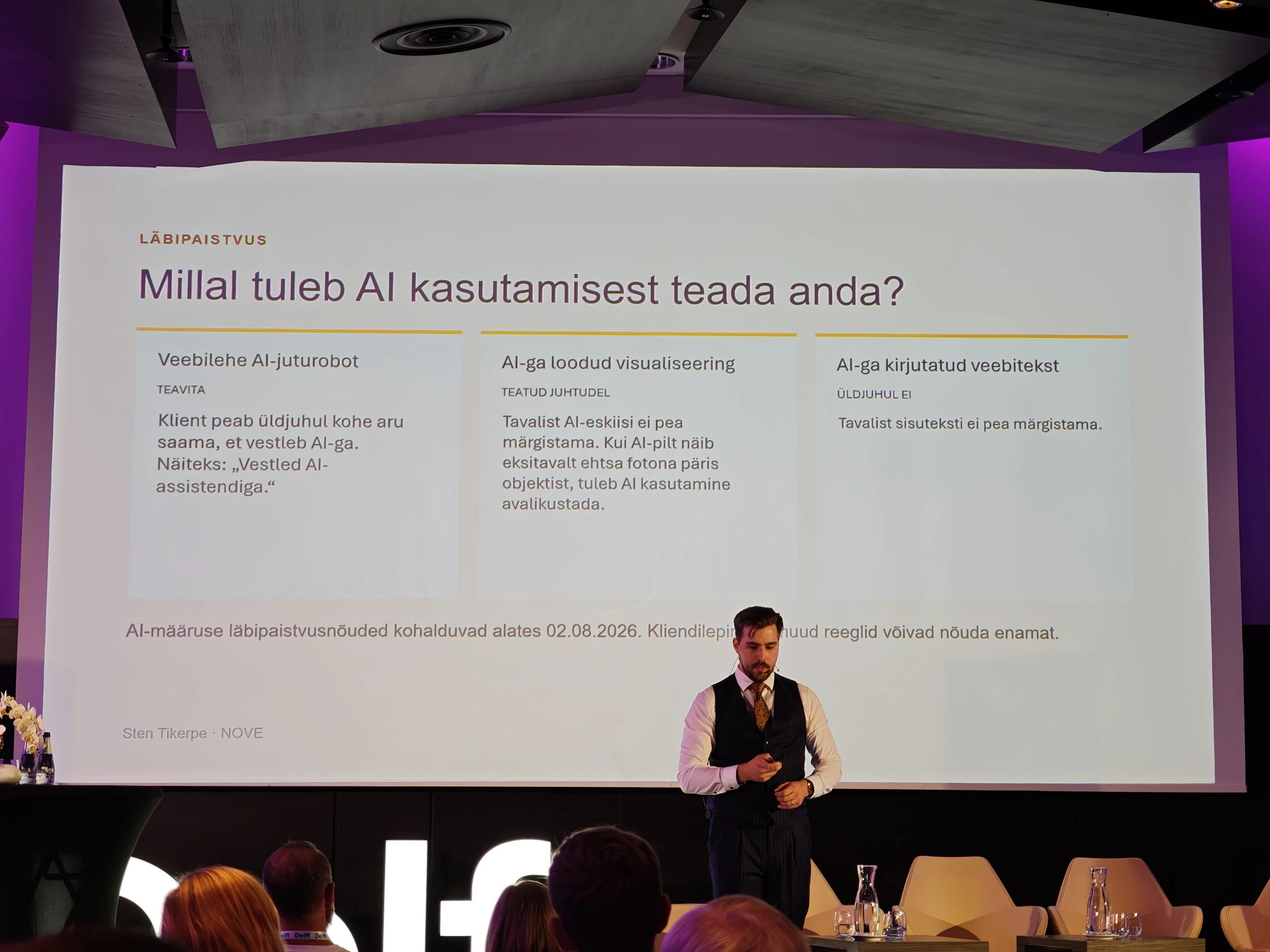
Under the CLOUD Act, obligations to disclose data controlled by a provider subject to US jurisdiction can extend to data held abroad. A European server alone therefore does not remove the risk arising from US law. That does not mean unlimited, automatic access. US Department of Justice explanation.
It also does not mean that US law simply cancels the GDPR. European Data Protection Board guidance explains that an order from a third-country authority is not automatically recognised or enforceable in the EU. Disclosure of personal data must also meet the GDPR’s legal-basis and international-transfer requirements. EDPB guidance on Article 48 GDPR.
For a construction business, the practical question is which project files and personal data may be put into the selected service, under what conditions and with whose approval. The data centre’s location is one part of that assessment.
AI can also reduce people’s workload
Andero Teras’s presentation covered workload, attention and mental resilience. For me, its emphasis on AI’s risks was too one-sided. The gloomy picture I heard does not match what I see in my work and hear from colleagues.
Colleagues have told me that AI has reduced their workload and made their working day much easier. They are happier because repetitive tasks no longer take as much time. That experience deserves to be taken just as seriously as concerns about the possible loss of skills.
Some have described occasionally starting a preparatory task while away so there is less work waiting when they return. A smaller backlog and a calmer return are tangible benefits for them. Working on holiday does not need to become anyone’s obligation for that to happen.
AI can reduce the workload and leave people with more energy for the substantive parts of their work. For me, that received too little attention in the presentation. I also want to judge AI’s impact by whether someone finishes the day less tired and with a clearer head.
Why I would go again
I would go again because hearing about other people’s experiences and solutions is useful. But high expectations set by an introduction need to be backed up by what is shown on stage. AI is developing quickly, and at the next conference I want to see how far things have moved forward.
I expect complete workflows, clearly described limitations and concrete examples of what went wrong in use and how it was fixed. Claims about data and security need the specific service, plan and source alongside them. A conference should leave people with knowledge they can use to make decisions. Unchecked generalisations do not do that.
I also wrote about getting construction data in order before introducing AI following this event. If you want to work through the use of Bauhub MCP and AI in your company, I can help with setup, a suitable workflow and training your people. Explore help with Bauhub and AI adoption.