
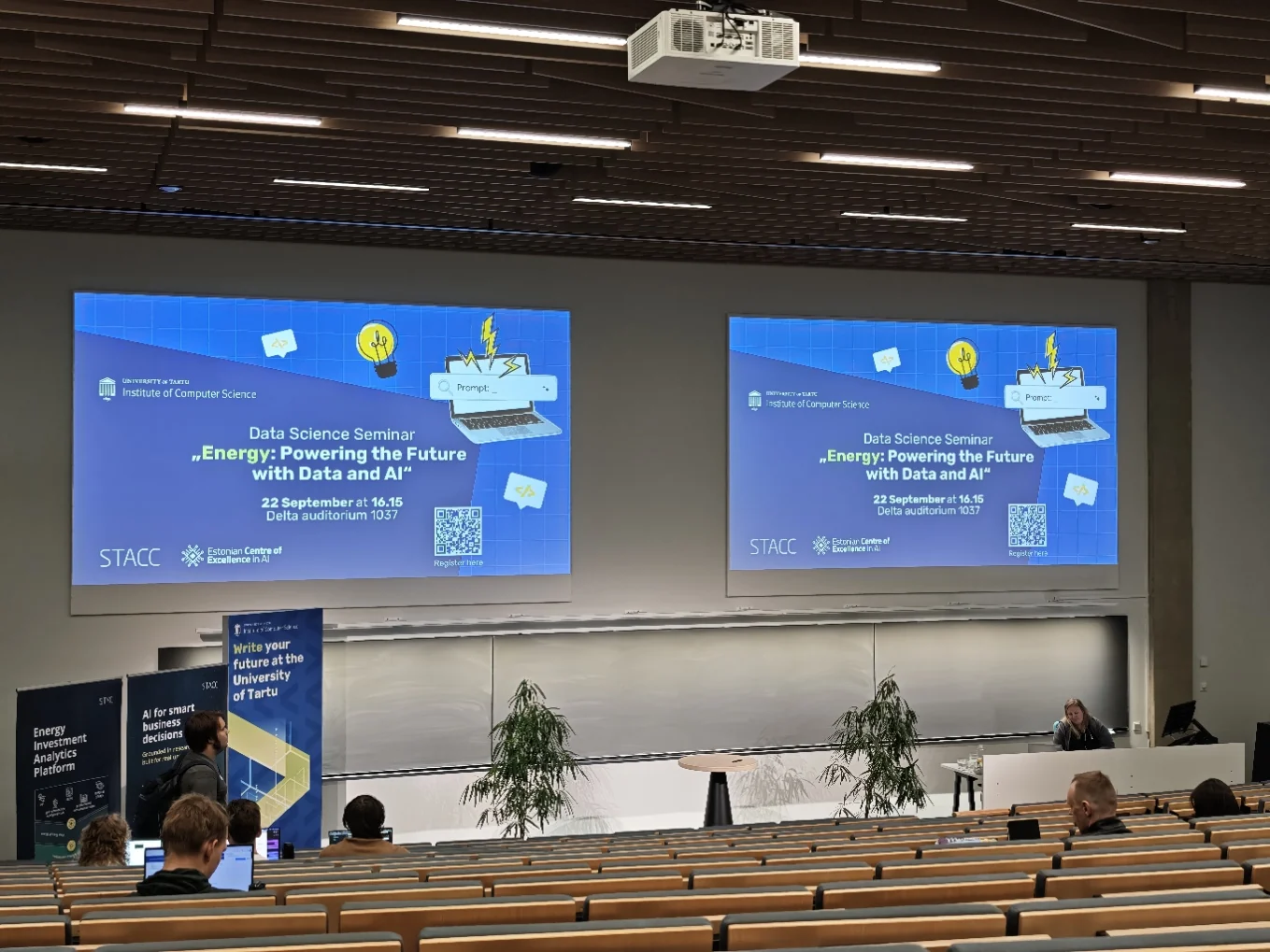
On 22 September, I attended the academic year’s first data science seminar at the University of Tartu’s Delta Centre. The topic was ‘Energy: Powering the Future with Data and AI’: how data and AI are being applied in the energy sector.
Batteries, electricity trading, weather forecasts and the grid. Concrete applications where an AI-assisted decision has a tangible consequence.
What should a battery do in the next 15 minutes?
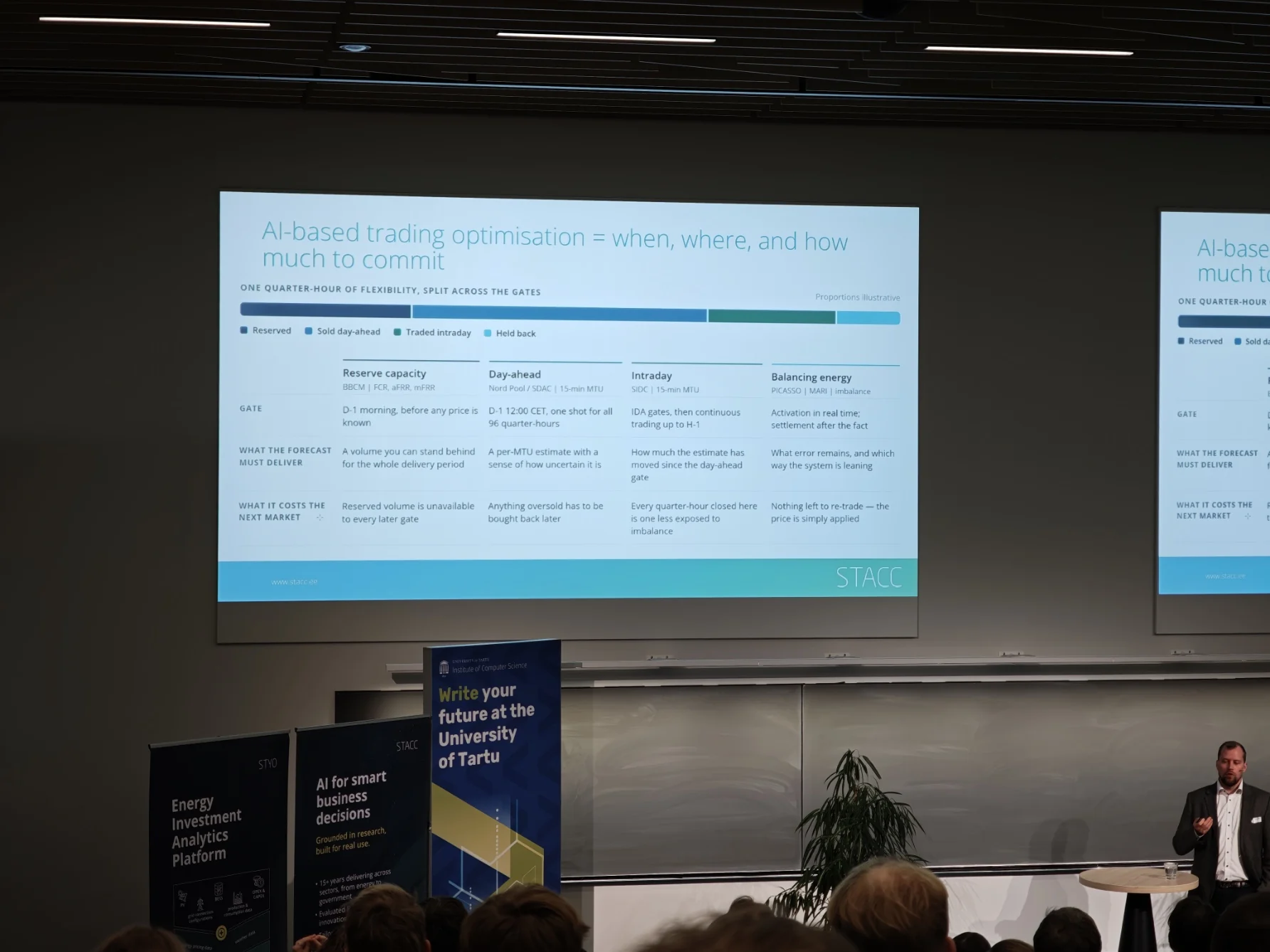
Siim Meeliste from STACC focused on 96 decisions a day: one for every 15-minute interval. When should a battery charge, sell energy or keep capacity in reserve?
One battery, several possible uses. Prices, forecasts and the effect of today’s choice on later options all matter. The same hardware can deliver different results depending on how it is managed. STACC’s seminar introduction describes AI’s role in making these choices.
My everyday AI experiments mostly concern computer-based work. Here, the same question appears at another scale: how can data help us make recurring decisions better?
Weather also affects a power line’s capacity
Markus Lippus from GridRaven spoke about ‘Weather as Grid Capacity’. Wind cools power lines, influencing how much electricity they can safely carry. GridRaven’s solution uses highly local weather forecasts to estimate this, accounting for terrain, trees and buildings.
It is a useful example of better data making existing infrastructure more effective. The question is not only whether to build a new line, but what an existing line can carry under current conditions.
The seminar also covered the other side of the relationship: AI itself needs energy. We have to consider both how AI helps manage electricity systems and how much power the computers behind it require.
These practical applications are what interest me. AI can be useful in very different places, from work on my computer to managing power grids and batteries.
Seminar programme and speakers on the University of Tartu website.
The value of an AI application needs to be assessed against its specific task. The Tallinn Data Week notes on measuring AI benefits also consider measurement and checking results.