
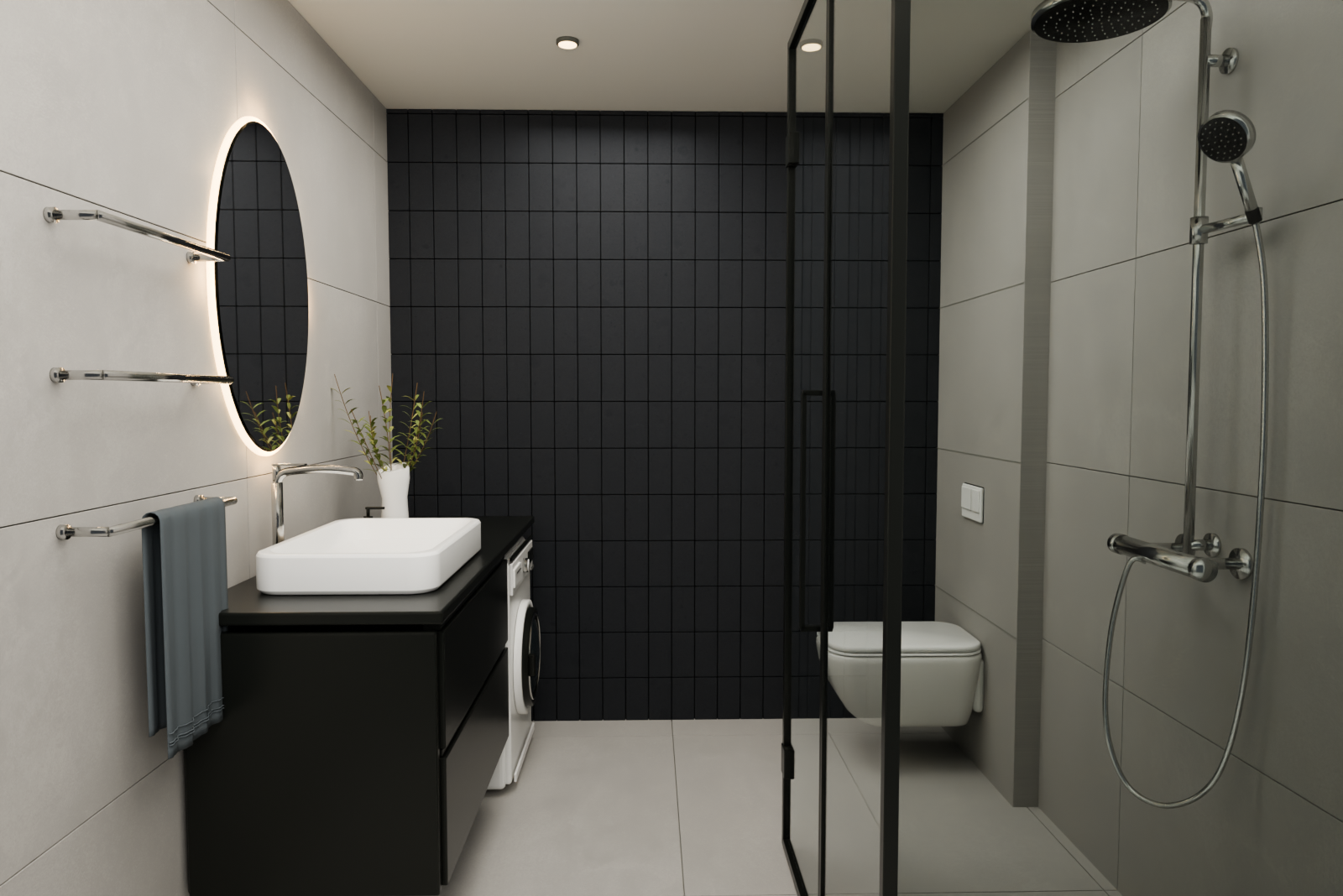
We took one image of a shower room at Raatuse Residentsid and used OpenAI Codex to build a 3D view you can walk around. By my estimate, the first working version was ready in about half an hour.
I still find it remarkable that this is possible. You have one image and an idea. A little later, you can open the room, move towards the basin, look into the shower area and choose your own viewpoint.
Open the 3D shower room and try it. The demo interface is in Estonian. Drag with your mouse or finger to look around. Use the arrow keys or on-screen controls to move, or start the automatic tour.
My thoughts immediately turn to how we work. If AI can build this on a computer, I can do something else meanwhile: walk, run or tidy the house. I can explain the idea and let the work continue.
The first test video. The video below is the very first result of this experiment. It stutters and flickers in places. I have kept it to show the starting point. You can try the current interactive 3D version on a separate page, where you can move around the room and choose where to look.
I talk, the computer builds
I mostly communicate with AI by voice. I spoke the ideas for this article aloud first, too. I explain what I want, add the necessary material and clarify it through conversation. That becomes a task AI can work on.
I like being able to step away from the computer without all progress stopping. I can go for a walk and return to see how far it has got, then explain what I like, what needs changing and what to try next.
We are used to computer work meaning sitting at the computer ourselves. Every change, experiment and next step passes through our hands. More of that work can now be delegated to AI. I retain the idea, direction and decision about whether the result meets my needs.
That does not mean every task works on the first attempt. Sometimes I need to explain the request more clearly or improve the result. But being able to have a technical solution built and then review something functional makes a substantial difference to me.
How did a shower-room image become a 3D view?
I gave Codex the reference image and asked for a spatial view. Codex wrote code, built a 3D model in Blender and created a browser-based viewer. Blender was the tool used to construct the room and its fittings.
The image showed light stone tiles, a dark back wall, a black vanity unit, an oval mirror and a glass shower enclosure. The model lets you view these from different angles. A customer can open a link and explore the room without installing 3D software.
By half an hour, I mean the first working version of our experiment. Polishing the current web view and making later corrections took additional work.
Dimensions derived from one image are approximate, and hidden areas are interpreted. It is suitable for presenting an idea and exploring a room layout. Accurate design or checking whether furniture will fit requires correct measurements.
Even the first demonstration has considerable value for me. I can make an idea visible quickly, show it to someone and discuss it together. Experimenting becomes much easier.
And the next ideas follow immediately
If we can turn a shower room into a 3D space like this, I want to try the same with products: furniture a customer can rotate on a website, or equipment whose parts and operation they can inspect more closely.
Those would be further experiments. Each product needs its own reference information and accuracy checks, but the opportunity to try an initial version quickly already exists. In my earlier AI product-image experiment , everything also started with a simple image. This time, the image became something you can move around inside.
Sometimes the biggest obstacle to an idea is how long it takes to try. If implementation seems to mean days or weeks at the computer, it is easy to put it off. A half-hour experiment makes me more willing to consider what else I could attempt.
To me, that is a future we have already entered. I can talk through an idea, let AI implement it and continue with my day in the meantime. It still feels a little extraordinary, even while I can explore the finished room.
These are the hands-on experiments I want to share in my AI training. If there is a task or idea you would like to try with AI in your business, get in touch.